Peppermint is the oil almost everyone buys second — and the one most people overdo. The aroma works instantly, the cooling sensation is immediate, and many conclude from this that more must be better. It is precisely the other way round.
What it actually is
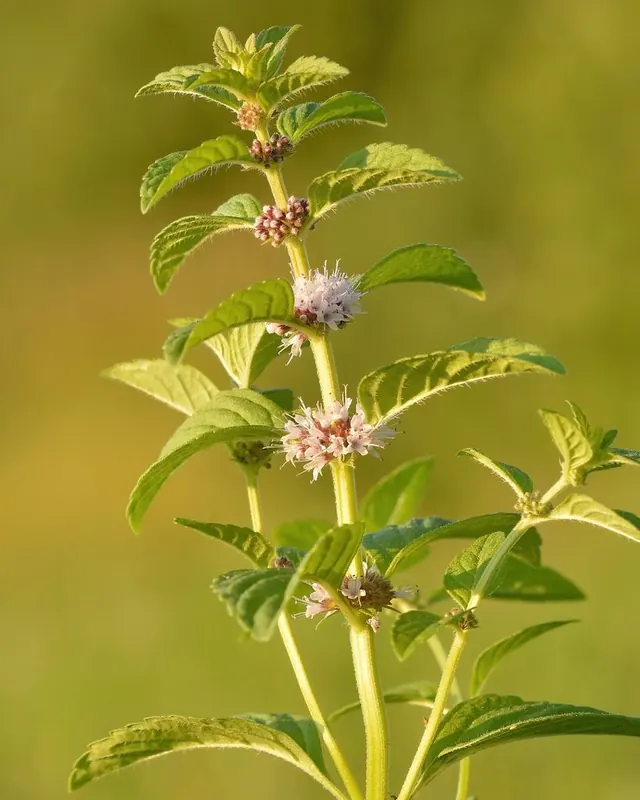
Mentha piperita is a hybrid of water mint and spearmint. The oil distilled from it is characteristically high in menthol and menthone — menthol is what produces the cool sensation, without the skin’s temperature actually dropping. It is a receptor trick: menthol activates the same cold-sensing receptor that real cold does.
- Extraction: steam distillation of the shoots before flowering
- Origin: United States (Oregon, Washington), India
- Aroma: sharp, clean, faintly sweet, long-lasting
How I use it
In the air, during the day. One or two drops is enough. Seriously: one or two. Peppermint dominates a room, and above three drops it can become oppressive, especially in a small space.
On the nape and neck — heavily diluted. At 1% (six drops in 30 ml of carrier oil) after a long day at a screen. The cooling sensation alone is pleasant.
After sport, on the legs. In carrier oil, at 1–2%.
In blends. It works surprisingly well with lavender, and lavender’s softness tames it. With lemon it is lively; with juniper, more masculine.
Where to be careful
With peppermint, dilution is not a recommendation but a condition. At high concentration menthol causes a burning sensation and skin irritation, and this kind of irritation does not go away because you “get used to it”.
| Consideration | Peppermint (M. piperita) |
|---|---|
| Dilution on adult skin | 0.5–1.5%, never more |
| Near the face | Avoid, especially around the eyes |
| Children | Not under 6 — menthol can trigger a breathing reflex |
| Pregnancy, breastfeeding | Ask your doctor |
| Phototoxicity | None |
In children under six, inhaling menthol can cause spasm of the glottis. This is not a theoretical concern — it is a documented occurrence. In a household with small children, peppermint belongs on a high shelf, and the diffuser should not run in a room where a child is sleeping.
If it gets on your skin undiluted and stings: do not try to wash it off with water. Oil does not dissolve in water, you will only spread it about. Apply plenty of carrier oil (sunflower, olive, whatever is to hand) and wipe it off with that.
How to recognise good quality
The most common adulteration with peppermint is added synthetic menthol, or blending in the cheaper Mentha arvensis (corn mint). The latter is naturally far higher in menthol, and its aroma is much sharper and more one-dimensional.
- Real peppermint oil smells complex: alongside the menthol there is a faintly sweet, herbaceous lower layer
- If it is only “cold” and nothing else, be suspicious
- The botanical name should be Mentha piperita, not arvensis
Common questions
Does it deter rodents? This is the most common claim online. In practice: it bothers them temporarily, it does not solve the problem long term. Do not build on it.
Can I put it in my tea? No. Mint tea and mint essential oil are two entirely different things — the oil is hundreds of times more concentrated.
How long does it keep? Three to four years, in dark glass, somewhere cool.